Building Enterprise Agentic AI Systems — Episode 1
In the last article, I laid out the Enterprise Agentic AI Reference Architecture — the full map of what an enterprise AI platform actually looks like. Now I want to start walking through it, component by component, beginning with the very first thing a request ever touches: the AI Gateway.
The demo flow everyone starts with
Almost every AI demo you've seen — and honestly, most of the ones I've built myself — follows the same three-step flow:
User → Application → AI Model
The user types something, the application forwards it to a model, the model answers. Clean, fast, and perfectly fine for a prototype. If you're validating an idea over a weekend, this is exactly how you should build it.
The trouble starts when someone says the words "let's roll this out to the organization."
The questions a prototype never has to answer
The moment a request enters an enterprise environment, a whole set of questions appears that the demo flow simply ignores. Who is making this request? Are they actually allowed to see the data they're asking about? Does the request violate any organizational policy — data residency, confidentiality, acceptable use? Which internal tools and systems should the agent be permitted to call on the user's behalf? Which model should handle it — and does that choice depend on cost, sensitivity, or capability? And when the audit or compliance team comes asking six months from now, where is the record of what happened?
Here's the part I see teams get wrong most often: they try to answer these questions inside the application, or worse, they hope the AI model will somehow handle them. It won't. It can't. A model has no concept of your identity provider, your RBAC rules, or your audit requirements. These are platform responsibilities — and they need a home.
Enter the AI Gateway
That home is the AI Gateway: the single, controlled front door through which every AI request in the organization must pass.
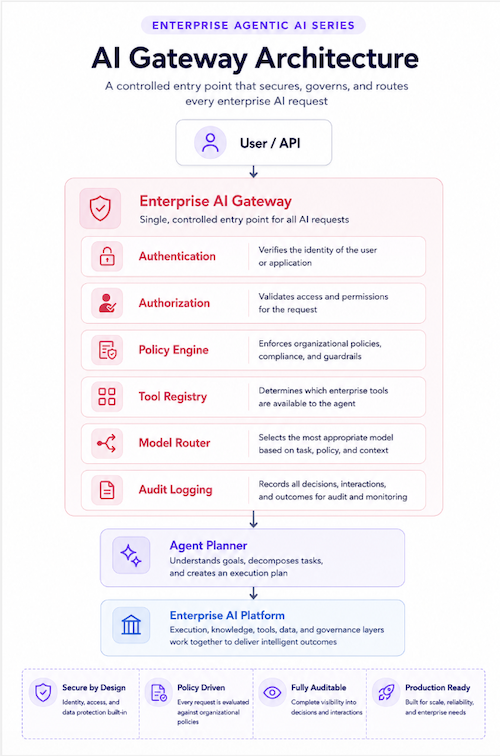
Before any reasoning happens, the gateway takes the request through a fixed sequence of checks:
Only after a request clears every one of these gates is it handed to the Agent Planner, where the actual reasoning and task execution begin.
Is this glamorous? Not really. Nobody puts "audit logging" on a conference slide. But in my experience, this unglamorous layer is precisely what separates a demo from a platform an enterprise will actually trust.
Seeing it in action: the AI Gateway Lab in NexusIQ
Concepts like this land much better when you can watch them happen, so I built a small AI Gateway Lab inside NexusIQ, my multi-agent governance platform.
In the demo, you follow a single enterprise AI request as it moves through the pipeline — authenticated, authorized, evaluated against policy, matched to tools, routed to a model, and logged — before finally reaching the Agent Planner. Watching the request get inspected and stamped at each stage makes the "why" of the gateway obvious in a way no diagram ever quite manages.
The one thing to remember
If you take a single idea from this article, make it this: applications should never talk to AI models directly in an enterprise. Identity, policy, and accountability all live in the gateway — and only requests that earn their way through it deserve to reach the reasoning layer.
In enterprise AI, the model answers the question — but the gateway decides whether the question should be answered at all.
Next episode
With the front door covered, we move inside. Next up is the Agent Planner — the component where an enterprise AI system starts turning a business goal into a concrete, executable plan.
If you're following the series, I'd genuinely love to hear which gateway responsibility your organization finds hardest to get right. My bet is on policy evaluation — it's the one everyone underestimates