Building Enterprise Agentic AI Systems – Episode 5
The Agent Planner can reason about a business problem, but reasoning alone doesn't create business value.
To answer a customer question, generate a report, update a CRM record, or execute a workflow, the agent must interact with enterprise systems.
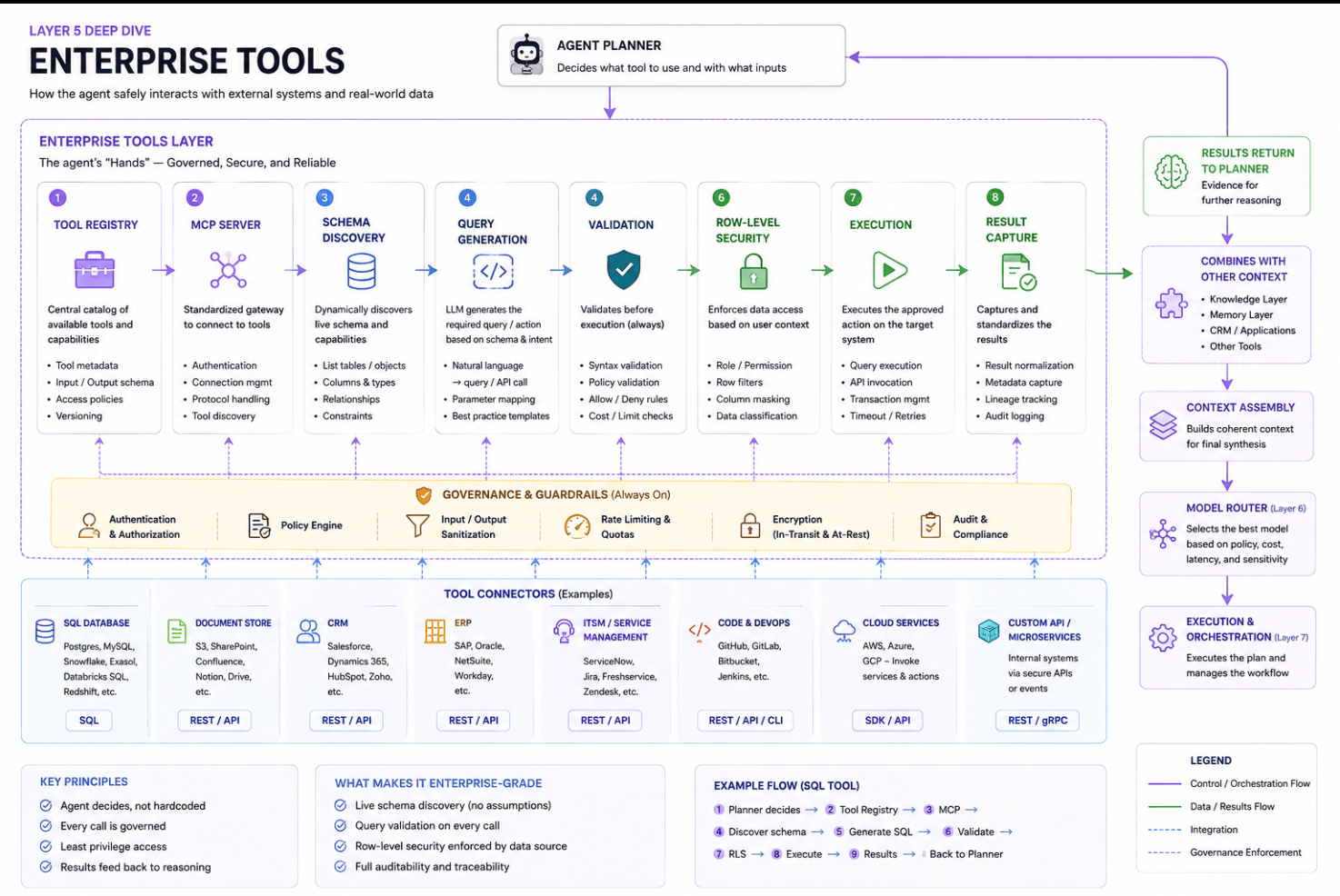
This is the responsibility of the Enterprise Tool Layer.
Unlike traditional software where integrations are hardcoded into the application, modern enterprise AI platforms expose capabilities as governed tools that the planner can discover and invoke dynamically.
The planner doesn't know how to execute SQL, call Salesforce, or send an email.
It simply understands what needs to be done.
The Tool Layer determines how it is safely executed.
Step 1 — The Planner Chooses the Tool
The planner begins by analysing the user's intent.
For a request such as:
"Analyse churn risk and recommend actions."
it determines that multiple sources of evidence are required.
Instead of following a predefined workflow, it reasons about which enterprise capabilities are needed.
For example:
Each capability is represented as a tool that can be selected independently.
Step 2 — Enterprise Tools Execute Under Governance
Selecting a tool does not mean executing it immediately.
Each tool follows its own execution pipeline.
For a SQL tool, this typically includes:
These controls ensure the agent operates within enterprise policies rather than relying solely on the language model.
Step 3 — Tools Produce Evidence, Not Answers
One of the biggest misconceptions about AI agents is that tool execution immediately produces the final response.
It does not.
A SQL query returns evidence.
A CRM lookup returns evidence.
A document retrieval returns evidence.
An API call returns evidence.
Each result is sent back to the Agent Planner, which combines information from multiple sources before deciding what the model should generate.
This distinction is fundamental.
Enterprise tools collect facts.
The planner synthesizes those facts.
The language model communicates the final answer.
Key Architectural Principle
Enterprise tools are not integrations hardcoded into an AI application.
They are governed capabilities that the Agent Planner can discover, select, and orchestrate dynamically.
This separation enables:
Architecture Insight
The real value of the Enterprise Tool Layer isn't that an AI agent can execute SQL or call an API.
The value is that every action is selected by reasoning, executed under governance, and returned as trusted evidence for the planner to incorporate into its broader decision-making process.
In other words, enterprise tools don't make the AI smarter.
They make the AI capable of acting safely within enterprise systems.
Refer Demo -