Understanding the Architecture Behind Enterprise AI Agents
Artificial Intelligence has evolved rapidly over the last few years. We started with predictive models, moved into generative AI with Large Language Models (LLMs), and are now entering the era of
Agentic AI
Every few months, a new framework, model, or agent platform appears. Most discussions revolve around autonomous agents, reasoning models, prompt engineering, or the latest benchmarks. While these topics are interesting, they often overlook the bigger picture.
Enterprise AI is rarely about deploying a single model
It is about designing an intelligent system capable of understanding business goals, retrieving enterprise knowledge, interacting with business applications, making informed decisions, executing actions safely, and operating under strict governance.
In other words, enterprises are not building AI models.
They are building AI systems.
That shift is what this series is about.
From Models to Intelligent Systems
Large Language Models fundamentally changed how software interacts with information.
Instead of writing complex search logic or predefined decision trees, applications can now understand natural language, summarize documents, generate code, explain data, and answer questions.
However, an LLM alone cannot solve enterprise problems. Consider a simple business request:
"Review this quarter's sales performance, identify underperforming regions, create improvement recommendations, and schedule a follow-up meeting with the regional managers."
Answering that request requires far more than text generation.
The system must:
None of these capabilities belong to the language model itself.
They belong to the surrounding architecture. This is why enterprise AI is evolving from model-centric applications into agentic platforms.
What Is an Enterprise Agent?
Many demonstrations present an AI agent as a chatbot capable of calling a few APIs.
Enterprise systems are significantly more sophisticated.
An enterprise agent is a software system capable of:
Enterprise AI Is an Architectural Problem
One of the biggest misconceptions surrounding Agentic AI is that building better agents primarily involves choosing better models.
In practice, architects spend far more time designing the surrounding platform.
Questions quickly emerge:
These are architectural decisions.
They determine whether an AI system becomes trustworthy enough for enterprise adoption.
A Reference Architecture for Enterprise Agentic AI
The following reference architecture illustrates how modern enterprise agent platforms are commonly organized.
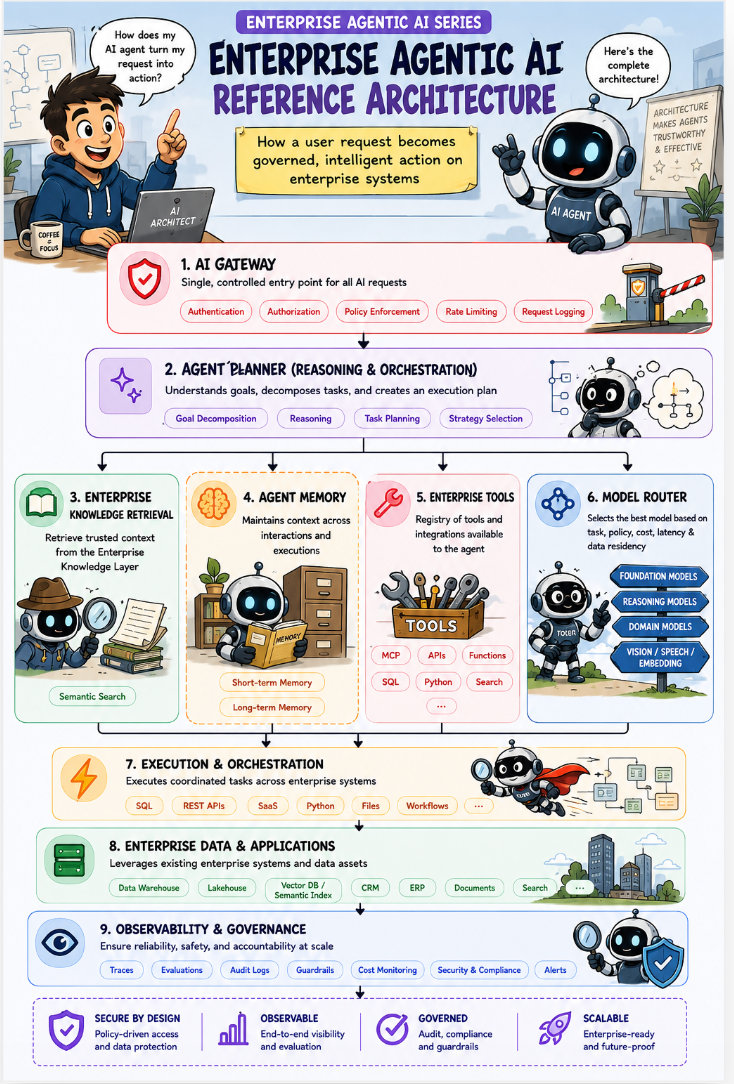
Rather than viewing an agent as a single component, think of it as a coordinated platform consisting of several specialized capabilities.
Let's briefly examine each layer.
Agent Planner
The Agent Planner is the reasoning core of the platform.
Instead of responding immediately, it understands the user's goal, breaks complex problems into smaller tasks, decides what information is needed, and determines which tools or models should be used before execution begins.
This planning capability is what separates enterprise agents from traditional chatbots.
Enterprise Knowledge Retrieval
Enterprise agents need trusted business context before they can make informed decisions.
Rather than relying on public information, they retrieve knowledge from the Enterprise Knowledge Layer—bringing together structured data, documents, metadata, and organizational knowledge to ground every response.
Agent Memory
Memory enables an agent to maintain context across interactions.
Short-term memory keeps track of the current conversation, while long-term memory allows the system to learn from previous interactions and provide more consistent experiences over time.
Enterprise Tools
Enterprise AI becomes valuable when it can interact with existing business systems.
Through a centralized Tool Registry, agents can securely access APIs, databases, MCP servers, workflows, and other enterprise capabilities without tightly coupling those integrations into the application itself.
Model Router
Modern enterprises rarely rely on a single AI model.
The Model Router selects the most appropriate model based on the task, organizational policies, cost, latency, or data residency requirements, allowing different models to work together within the same platform.
Execution & Orchestration
Once planning is complete, the execution layer coordinates actions across enterprise systems.
This may involve querying databases, calling APIs, running workflows, executing Python code, or interacting with SaaS applications to complete the requested task.
Enterprise Data & Applications
Enterprise agents don't replace existing systems—they work with them.
Data warehouses, lakehouses, CRM platforms, ERP systems, document repositories, and search services remain the systems of record, while the agent platform orchestrates access to them.
Observability & Governance
Enterprise AI must remain transparent and accountable.
Observability provides visibility into reasoning, execution, and system performance, while governance ensures every interaction complies with organizational policies, security requirements, and audit standards.
More Than AI Agents
This architecture is designed for more than a single AI agent.
The same foundation can support enterprise copilots, autonomous business agents, workflow automation, AI research assistants, developer agents, and multi-agent systems. Regardless of the use case, the core architectural principles remain the same.
What We'll Explore in This Series
This article introduces the reference architecture for Enterprise Agentic AI Systems.
In the upcoming articles, we'll explore each layer in detail—from planning and knowledge retrieval to memory, model routing, enterprise tools, execution, governance, and observability.
I'll also use NexusIQ throughout the series to demonstrate these concepts with practical architectures and working implementations.
Final Thoughts
Enterprise AI isn't defined by a single model or framework. It's defined by the architecture that brings models, enterprise knowledge, tools, governance, and business systems together.
As AI systems become more autonomous, building reliable, secure, and governed platforms will matter just as much as choosing the right model.
That's the journey we'll explore throughout this series.
Welcome to Building Enterprise Agentic AI Systems.