Building Enterprise Agentic AI Systems – Episode 4
In the previous article, we explored how the Enterprise Knowledge Layer helps an AI agent find trustworthy information. It generates embeddings, searches the vector database, reranks results, filters irrelevant chunks, and returns grounded context backed by citations.
That works well.
But it raises another question.
What happens when the exact same request arrives again?
Should the agent repeat the entire retrieval pipeline?
Should it search the same documents, rerank the same chunks, and generate the same answer again?
Many AI systems do exactly that. Every request is treated as a brand-new problem, even if the answer was already found a few minutes ago.
That approach works for prototypes, but it doesn't scale well in production.
Enterprise AI systems need to remember previous work. That's where Agent Memory comes in.
Retrieval Finds Knowledge. Memory Reuses It.
The Knowledge Layer is responsible for discovering the right information.
It generates embeddings, searches the vector database, reranks results, filters low-confidence chunks, and returns grounded context to the Agent Planner.
Agent Memory has a different responsibility.
It determines whether that work has already been completed.
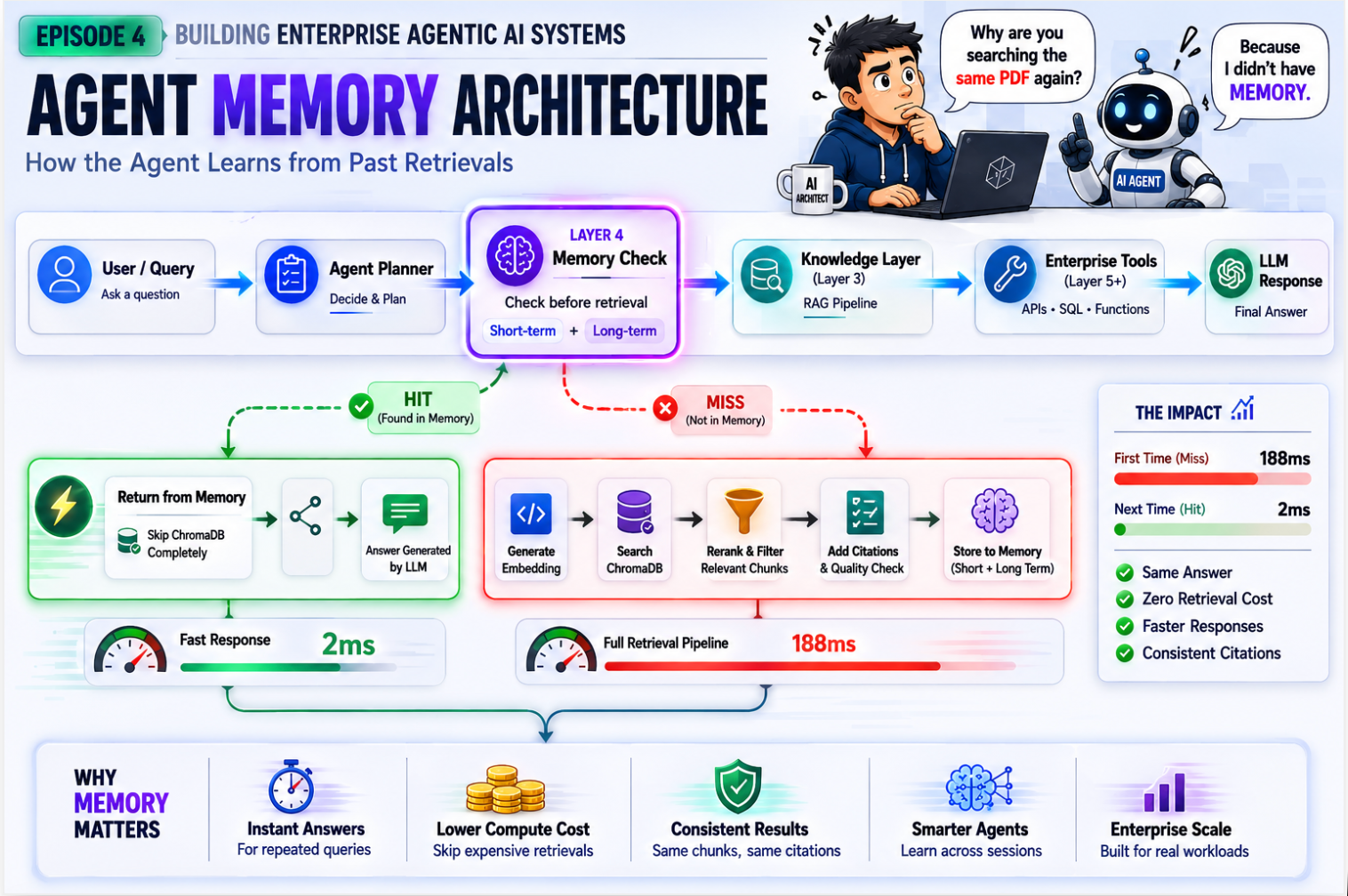
Instead of immediately invoking the retrieval pipeline, the planner first performs a memory check.
If a trusted result already exists, the agent simply reuses it.
If no suitable memory is found, only then does it execute the full retrieval pipeline.
This small architectural decision dramatically changes how enterprise AI systems operate.
Memory Before Retrieval
The key design principle is simple.
Memory is checked before the retrieval pipeline begins.
The execution flow becomes:
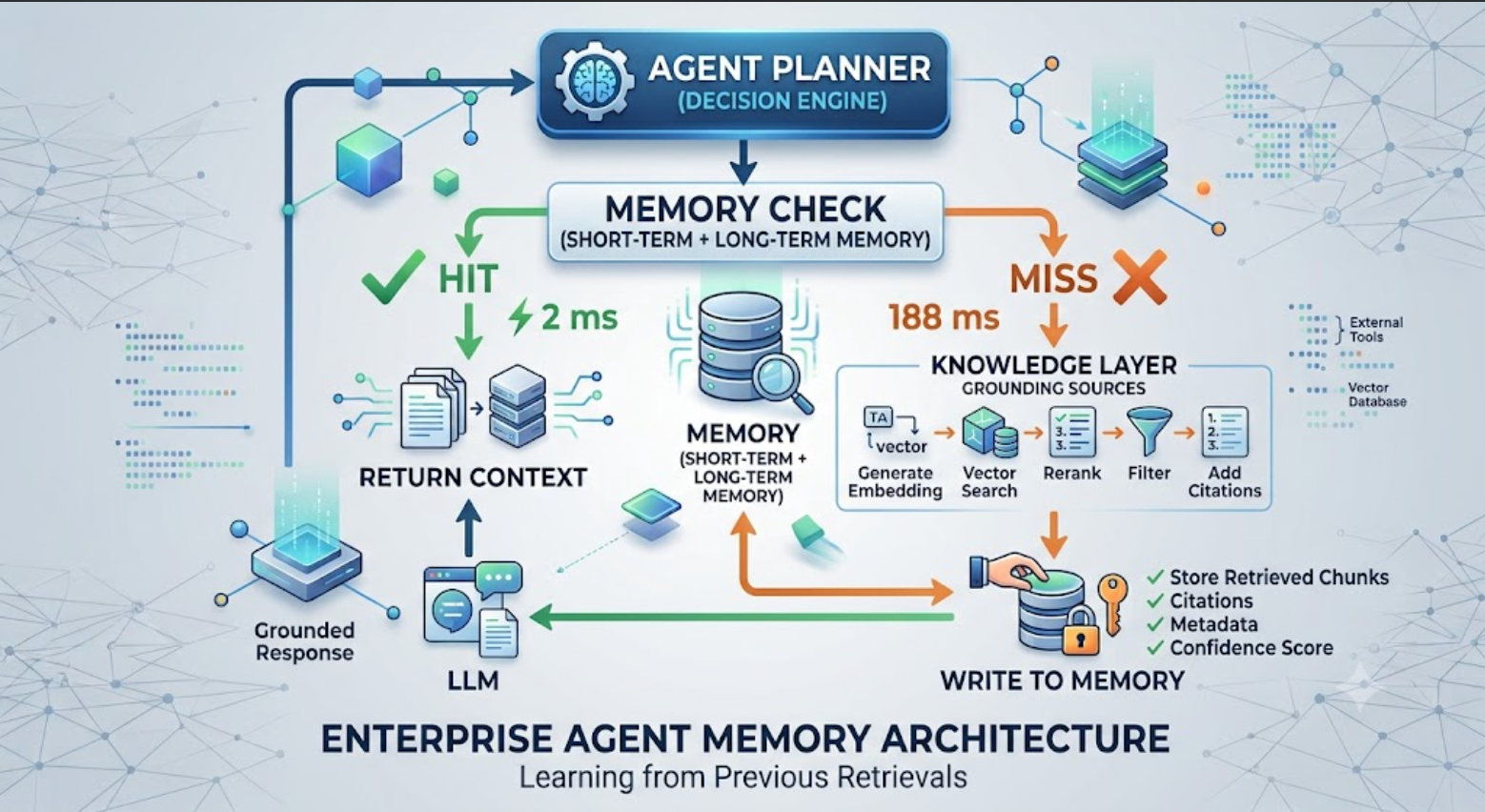
On a memory hit, the agent skips embedding generation, vector search, reranking, and citation retrieval entirely.
The previously verified context is returned immediately.
On a memory miss, the retrieval pipeline executes normally, and the resulting grounded knowledge is automatically stored for future requests.
See Agent Memory in Action
Theory is important, but enterprise architecture becomes much clearer when you see it executing.
In this demonstration, I walk through the complete Agent Memory workflow built inside NexusIQ, showing how an enterprise AI agent avoids repeating expensive retrieval operations.
You'll see:
The demo also explains how this architectural pattern improves response time, reduces infrastructure cost, and delivers more consistent answers across enterprise AI workloads.
Why Memory Matters
Without memory, enterprise AI agents repeatedly perform identical retrieval operations.
Consider a finance analyst asking:
"Summarise the Q2 Churn Analysis Report."
If the same request is submitted multiple times throughout the day, a traditional RAG pipeline repeats every retrieval step for every request.
Generate embedding.
Search ChromaDB.
Rerank results.
Filter low-confidence chunks.
Attach citations.
Return context.
Nothing has changed, yet the system performs the same expensive work again.
Agent Memory eliminates this unnecessary repetition.
The first request performs the retrieval.
Every subsequent request simply recalls the previously verified context.
The Benefits of Agent Memory
Adding a memory layer improves more than performance.
It improves the behaviour of the entire enterprise AI platform.
Faster Responses
A memory lookup is significantly faster than executing a complete retrieval pipeline.
In our NexusIQ implementation, repeated requests reduced response time from approximately 188 milliseconds to around 2 milliseconds.
Lower Infrastructure Cost
Embedding generation, vector search, reranking, and similarity calculations are among the most expensive parts of a RAG pipeline.
Skipping these operations reduces compute consumption and improves scalability.
Consistent Answers
Repeated retrievals can return slightly different chunks as indexes evolve or ranking scores change.
Memory returns the same grounded context, resulting in more predictable and consistent responses.
Better User Experience
Users expect repeated questions to produce fast, reliable answers.
Memory enables the system to behave less like a search engine and more like an assistant that remembers previous work.
Short-Term and Long-Term Memory
Enterprise AI systems often distinguish between two types of memory.
Short-Term Memory stores recent retrievals that are likely to be requested again during the current session.
This enables instant responses for repeated questions and follow-up interactions.
Long-Term Memory persists verified retrievals across sessions.
Frequently requested reports, playbooks, policies, and enterprise knowledge can be reused days or even weeks later without rebuilding the entire retrieval context.
Together, these layers allow the agent to learn from previous retrievals while remaining grounded in trusted enterprise data.
Memory Is More Than a Cache
It is tempting to think of Agent Memory as a cache.
While both improve performance, their purpose is different.
A traditional cache stores responses.
Agent Memory stores verified enterprise context.
That context includes retrieved chunks, citations, metadata, timestamps, and supporting evidence that can be reused by the Agent Planner.
The planner receives grounded information regardless of whether it originated from a fresh retrieval or from memory.
From the planner's perspective, both paths produce the same trusted result.
Looking Ahead
After four architectural layers, our enterprise AI agent can now:
The next step is transforming reasoning into action.
In the next article, we'll explore Enterprise Tools—the layer that allows AI agents to securely execute SQL queries, call APIs, invoke MCP servers, interact with business applications, and perform real enterprise operations rather than simply generating responses.